Summertime in full swing!
Exciting News about a Company Expansion
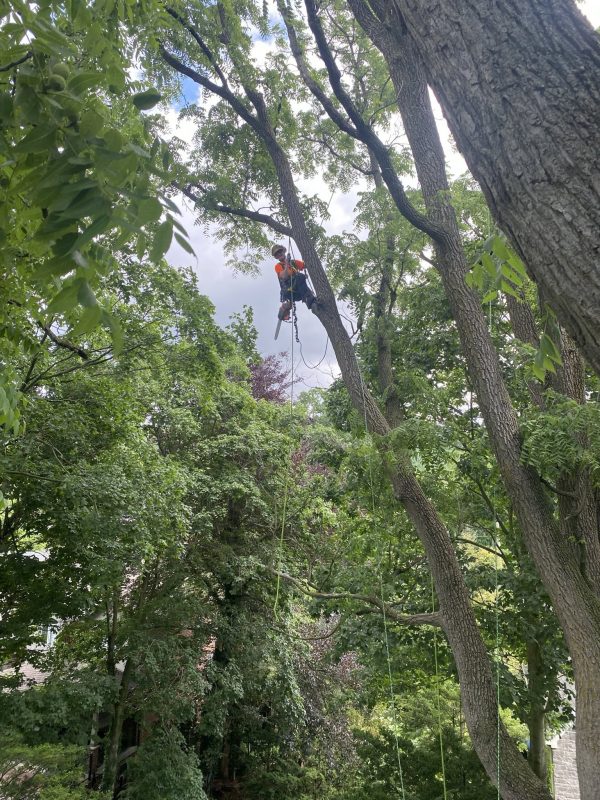
We are very excited to announce that Kyle and his wife Polina are expecting a new addition to their family this July! As their second child is expected very soon, Kyle has reduced availability for consultations and site visits. We are very lucky that Charlie Briggs, also a Board Certified Master Arborist and one of our Crew Leaders has been able to step in and help us out. Charlie’s move away from working at the Royal Botanical Gardens has been of great benefit to us at this very busy time of year.
Spring Workshop Series Wrap up
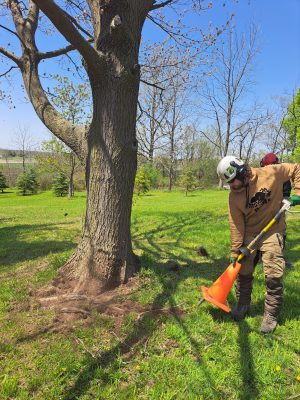
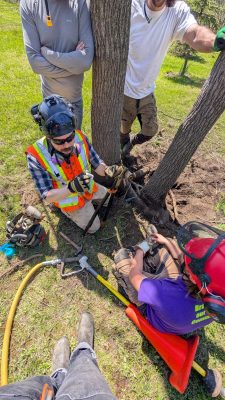
We had a blast getting into the dirt on May 10th at our third and final instalment of our Spring Workshop Series with “Fungamentals 3: Practical Root Pruning and Air Excavation Techniques.” Thanks to all of our spring workshop series attendees. We had a great time hosting everyone for the first three Fungamentals workshops. We are happy to take these off site for anyone interested in helping their team to hone their skills regarding working with trees and fungi. Please get in touch for more information.
New Article Series in Ontario Arborist Magazine
“Applied Fungamentals” is a new collection of articles that focuses on the practical ways to prevent problem fungi. This series will discuss pruning, planting, root management, construction protection, and advanced assessment – all with a lens on the relationship between trees and fungi.
The first article in this series appears in the June/July 2025 issue and is entitled “Fungamentals of Tree Planting Part 1: Selection and Inspection Above Ground.” The second part of this article will be in the August/September issue.
CBC Radio
Kyle has been dubbed the “Resident Tree Expert” on CBC Radio’s Fresh Air program. His appearances for tree health call-in segments have become so popular that he has been moved to a monthly segment.
If you missed his appearance on June 28th, you can listen here:
https://www.cbc.ca/listen/live-radio/1-193-fresh-air/clip/16155300-a-master-arborist-answers-listener-questions-trees
Kyle’s next appearances will be on Saturday, August 2 and Saturday, September 6 starting at 8:30 am.
McMaster Forest Consulting Project
McMaster Forest Nature Preserve is a 127 acre (51.5 hectare) property owned by McMaster University and designated as environmentally significant natural land, to be used for ecologically sensitive teaching, research and recreation purposes.
McMaster Forest Nature Preserve is an incredibly biodiverse area of mixed forests, old growth forests, wetlands, meadows, creeks, and prairie. The proximity to campus, combined with the incredible diversity of animal and plant species thriving on the property, make the McMaster Forest Nature Preserve an ideal research, recreation, and teaching facility. Many undergraduate courses make use of the property as well as undergraduate and graduate research projects.
The public is welcome to explore the area, but is asked to please adhere to posted signage, stay on trail, and not disturb ongoing research.
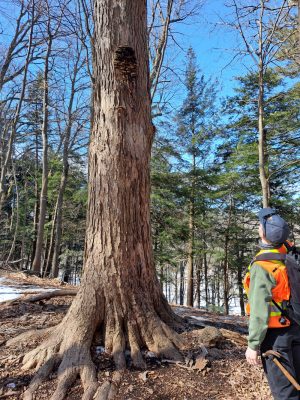
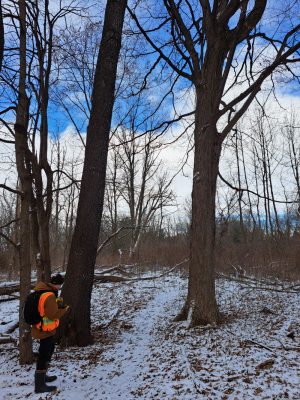
Ironwood has been involved on this property with a consulting project that has spanned many years and has just completed its third phase. Our work here is to conduct tree risk assessments to ensure the safety of visitors to the Mac Forest and help with proper forest management. This is done by recording field data on a map using GIS software. Our team helps to prioritize tree work on the site by the level of risk.
To learn more about the McMaster Forest, check out their website here: https://nature.mcmaster.ca/mcmaster-forest/
IQQQ – Ironwood Quarterly’s Question of the Quarter
Question from a colleague:
One of our clients got in touch with a question about her beloved catalpa tree that our team pruned this past winter:
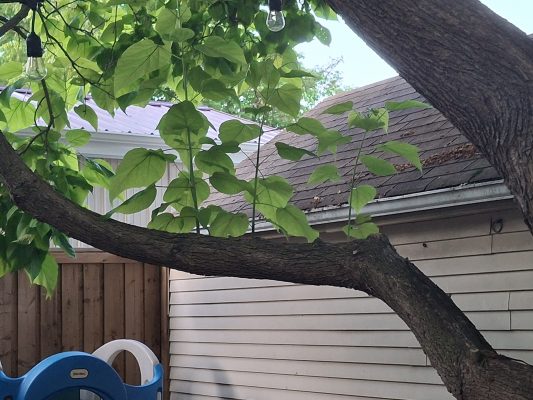
Our Catalpa has grown these three branches. Should we prune them now or is it better to wait until fall?
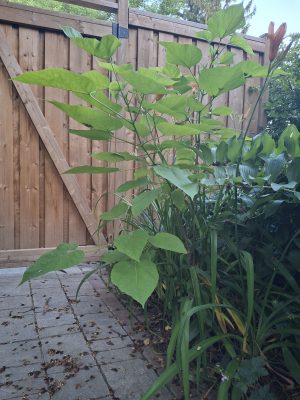
Also – we have two baby Catalpas growing in our garden. Is there a way to dig them out and preserve them without hurting the surrounding garden?
Answer:
The three suckers on your catalpa are the tree’s response to the reduction pruning Ironwood completed earlier this year further out on that same limb. Since end branches with active buds were removed, the tree has excess energy that it has redirected to dormant buds further down that limb.
There is no right or wrong answer when it comes to deciding to prune, or not to prune, the suckers off. They are providing no harm to the tree but If you prefer the aesthetic of their absence then feel free to remove them.
Regarding your volunteer seedling catalpas. Yes, you should have luck potting them up to plant where you see fit. Be sure to collect as much of their root zone as possible while considering the other plants in your garden.