
Internet of Nature Podcast
Kyle had the opportunity to sit down with Nadina Galle for a fascinating discussion on the Internet of Nature Podcast: “Mushrooms Aren’t a Death Sentence” — Fungumentals for Arborists Who Diagnose Before They Cut.
In this episode they discuss how fungi reshape tree health, why “there’s a mushroom” isn’t a diagnosis, and how arborists can move from reactive removals to true preservation.
Follow the link below to listen to their discussion about the amazing relationship between trees and fungi.
https://internetofnature.substack.com/p/s6e10-mushrooms-arent-a-death-sentence
Spring Workshop Series
We are excited to once again offer our spring workshop series for green industry professionals. Workshops 1 and 2 will be held in Stoney Creek, and workshop 3 will be held in St George, Ontario on the following dates:
March 28 – Fungamentals 1: Mycology for Arboriculture and Urban Forestry
April 18 – Fungamentals 2: Small Tree Planting Pruning and Preservation
May 9 – Fungamentals 3: Practical Root Management and Air Excavation
Please get in touch to get on our waiting list for more information.
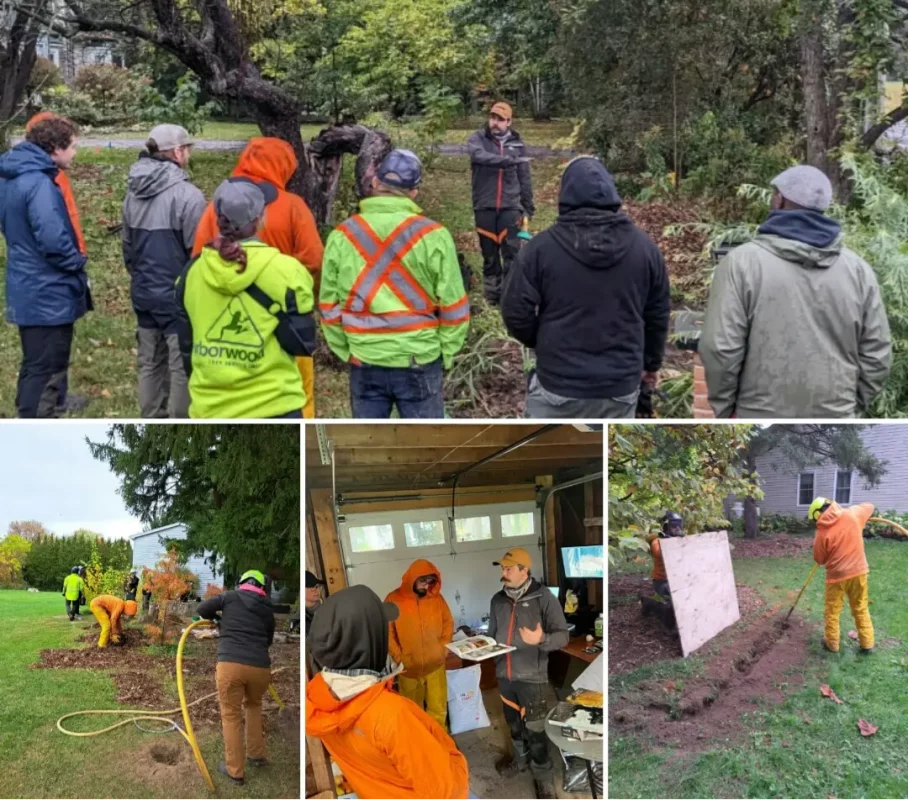
These workshops are designed with the green industry professional in mind, but we are working towards a full day Fungamentals workshop for laypeople – gardeners, naturalists, and other nature-enthusiasts. Please let us know if this is something that would interest you!
Upcoming Professional Development Events
February 18-20 – ISA Ontario Annual Conference and Trade Show – Ironwood staff presenting on the following topics:
- “Buds and Branches – A Winter Tree ID Hands on Workshop”
- “Large tree wounds – Do nothing? Or help the tree? The Fungamental Decay Prevention Technique You Should Have Heard Of, But Probably Haven’t”
- “The Fungamentals of Pruning”
March 24 & 25 – Landscape Ontario Pro Dev Seminars –
- “Fungamentals 1” and “Theory of Fungamentals 2 & 3”
CBC Radio – Fresh Air
Upcoming tree health call-in shows on CBC Radio’s Fresh Air program will be Saturday, February 28th and March 21st, both dates starting at 8:30 am.
To listen to Kyle’s appearance on October 25th, follow this link:

Applied Fungamentals in Ontario Arborist
Kyle’s third series of articles is currently being published in ISA Ontario’s magazine Ontario Arborist. The upcoming Feb/March 2026 edition will contain his second part of the Fungamentals of Pruning.
IQQQ – Excessive Mulch & Sunscald
Question:
We have a contract with a housing complex with about 130 trees on the property, most trees are approx 25-30 years old. A good portion of the street trees have been excessively mulched to the point some of them have almost a foot of mulch piled up against the stems. We want to remove the mulch and work with the landscaping company to show them the proper technique for mulching. My question is how can we prevent sunscald? I understand that it is better to remove the mulch than leave it, and now (spring) may be the best time to do it because the leaves are starting to come out which will provide some coverage.
I assume there will be some advantageous roots in the mulch as well so I am hoping we will be able to preserve as many of them as possible and cover them with minimal soil/mulch to encourage them to eventually grow downwards.
Answer:
It’s always a tough call when in this position. I agree that removing the mulch is the best part and the sunscald and adventitious roots will definitely be a problem.
I advise:
- Removing small adventitious roots, as you want to retrain the tree’s bad habits. IF it’s full of woody roots then preserve, but if we’re talking small enough to prune with secateurs (5cm diameter or smaller), then don’t hesitate as they will only continue to grow in size and complication. Also remember the 10cm max guideline – avoid at all costs removals of roots 10cm or greater.
- As for sunscald, if you know you’re going to be back next year, I’d suggest tree wraps/tree guards. They will protect against rodent and mechanical damage as well as provide some shading of the newly exposed root crown.
- Another tactic, if you’re feeling bold and have the support of the client, is to paint the newly exposed areas with a white, latex based paint. This is a common practice in Europe and has been done for centuries in Mediterranean climates where there is a greater fluctuation in temperature. The purpose is to prevent trees from sunscald, and the diseases and stressors that come afterward. Some people like the aesthetic, and it does not need to be an annual application in our area.
- In cases where the decline is advanced, I’d prepare them for successional planting near the declining trees -something that is often much easier with an airspade than a shovel.